
Iowa County Criminal Court Cases
The Iowa County Clerk of Courts keeps the official file for state felony and misdemeanor prosecutions heard in Wisconsin Circuit Court. The clerk works at 222 N. Iowa St. in Dodgeville and can be reached at 608-935-0395. Counter hours are Monday through Friday, 8:00 a.m. to 4:30 p.m. Iowa County has one circuit branch. The official directory identifies Hon. Matthew C. Allen as its judge.
The three largest local communities have no municipal court listed in Wisconsin's municipal-court directory. That matters when tracing a citation. State crimes and local citations requiring court action flow to Iowa County Circuit Court rather than a separate Dodgeville, Mineral Point, or Barneveld docket. The District Attorney decides which criminal charges to issue after reviewing an agency referral. The clerk then opens the court case and maintains its filing, activity, judgment, and payment record.
Iowa County's One-Branch Criminal Docket
One branch does not mean one record source. Police and sheriff files stay with the agency that made or investigated the contact. The Iowa County District Attorney creates the charging complaint, while the circuit clerk controls the filed case. WCCA publishes public docket metadata from the court system. Each source answers a different question, so a police charge label may differ from the prosecutor's filed count or the court's final judgment without any record being wrong.
The official Iowa County District Attorney page shows where charging work occurs and what matters the office handles.
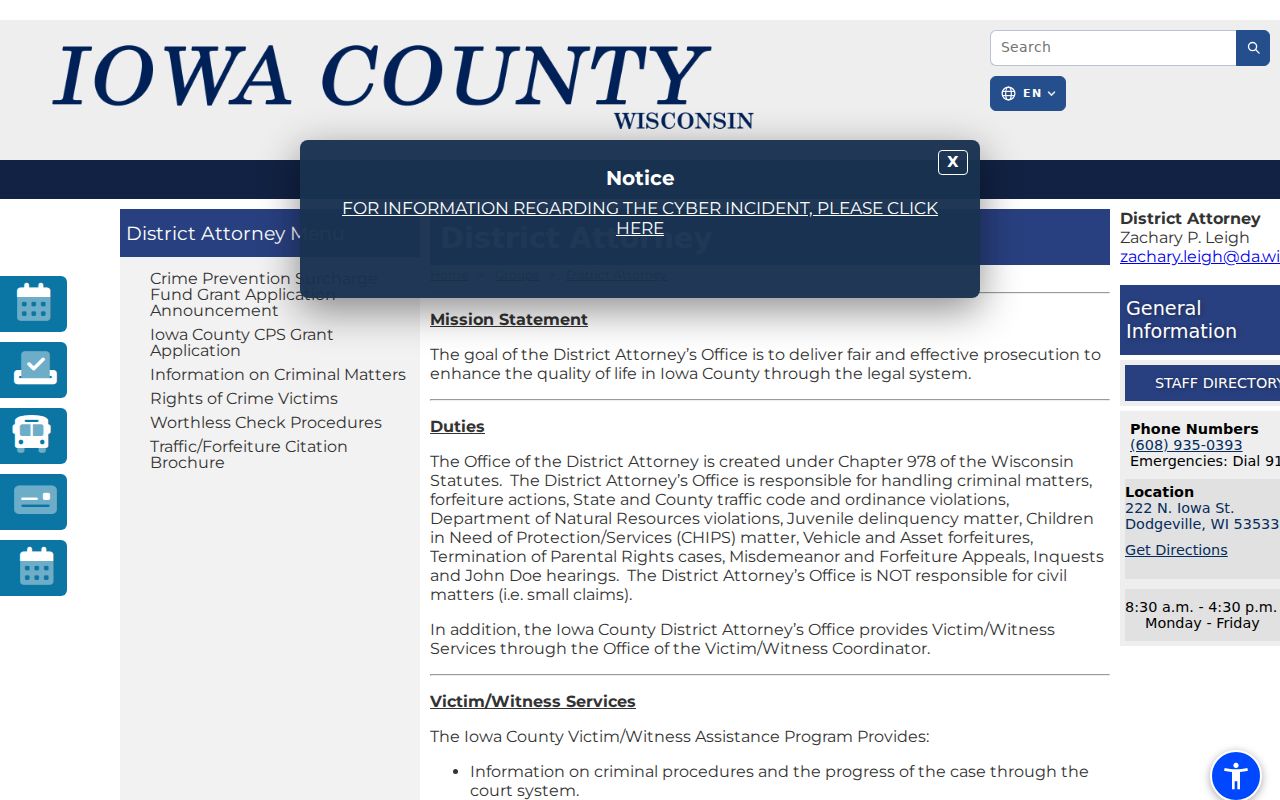
This office is part of the path from an agency referral to a filed Iowa County criminal court case, but the clerk remains the public case-file custodian.
Searching Iowa County Case Records
Begin with Wisconsin Circuit Court Access, the free public WCCA case search. Search options can change in the live interface, so use only the party, case, citation, county, and other criteria shown at the time of the search. Restrict the result to Iowa County when that option is available. A known case number is the cleanest key because names can be shared and may be entered in more than one form.
- Open WCCA, review its terms, and choose the public circuit-court case search.
- Enter the case number when known. Otherwise, use the available party or citation criteria.
- Limit the search to Iowa County and compare the caption, filing date, type, and status.
- Open the matching case number and read charges, court activity, judgment, sentence, and financial history.
- Take the case number to the Iowa County clerk when the complaint, motion, order, exhibit, transcript, or certified copy is needed.
WCCA's live fields are dynamic. The verified search routes are listed without guessing at controls the portal may add or remove.
| Search key | Use | Required | Iowa County check |
|---|---|---|---|
| Case number | Direct case lookup | No single field is always required | Match county and case type |
| Party criteria | Name-based search | Follow the live form | Compare identity details shown |
| Citation criteria | Traffic or ordinance trail | Follow the live form | Check circuit routing |
| County filter | Narrow statewide results | Use when exposed | Select Iowa County |
Note: Bring the case number because the statewide clerk fee schedule allows a $5 search fee when no case number is supplied.
Iowa County WCCA Case Record Limits
WCCA shows the docket, not a public stack of document PDFs. Its public fields can include the Iowa County case number, caption, filing date, case type and status, charges, attorneys, scheduled events, docket activity, judgment, sentence, and financial history. An order may appear as an event even though its text cannot be opened online. The Wisconsin Court System states that e-filed documents are not displayed to the public through WCCA.
The official WCCA interface illustrates the statewide search layer used for Iowa County cases.
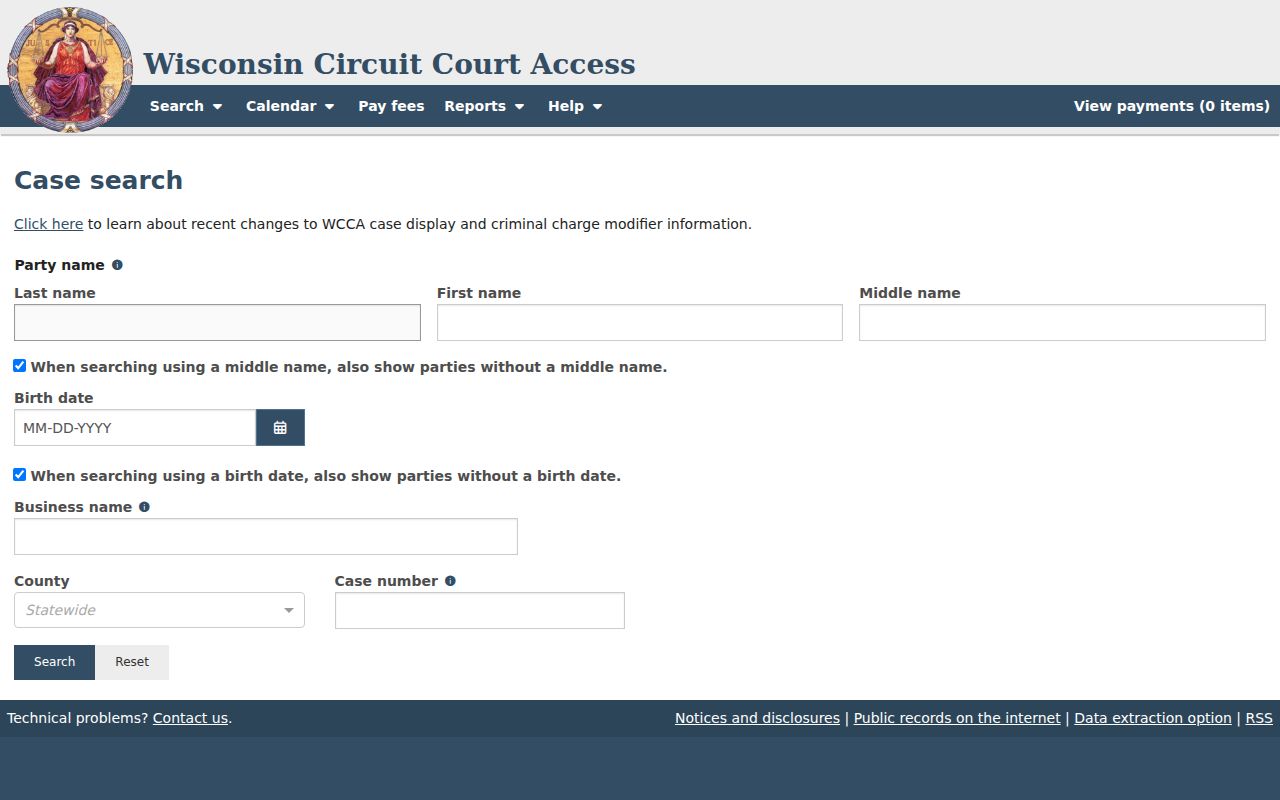
A useful online result is therefore a route to the file, not the file itself. Record the case number and exact docket entry before contacting the clerk.
Inside an Iowa County Case File
A filed court case records the prosecutor's accusation and the court's response. It may contain a complaint or information, motion papers, hearing records, orders, a judgment of conviction, sentence terms, and postjudgment filings. WCCA exposes the public metadata tied to many of those events, while open documents are inspected through the Iowa County clerk. The contents must be read charge by charge because one count may be convicted, another dismissed, and another amended.
| Case number and county | The unique court identifier and Iowa County filing location. |
|---|---|
| Caption and parties | The case title, named parties, and attorneys shown on the public record. |
| Charging record | The complaint or information setting out charges filed by the prosecutor. |
| Docket activity | A dated sequence of hearings, filings, orders, and later case events. |
| Charge disposition | The result for each count, such as conviction, dismissal, or acquittal. |
| Judgment and sentence | The formal outcome, sentence, conditions, restitution, and related financial entries where public. |
A case marked closed may still receive later activity. Appeals, amended orders, payments, or other postjudgment entries can appear after the main disposition.
Iowa County Clerk Computer Access
The clerk counter provides a public-access computer at the Dodgeville courthouse. Use it when the online index identifies the case but the needed filing is not visible. Most open case files may be inspected, though sealed or confidential material remains unavailable. For an older or archived Iowa County case, call 608-935-0395 before traveling and ask which name, case number, or date range will help staff locate it.
The clerk's official office page confirms the counter, public computer, address, and hours.
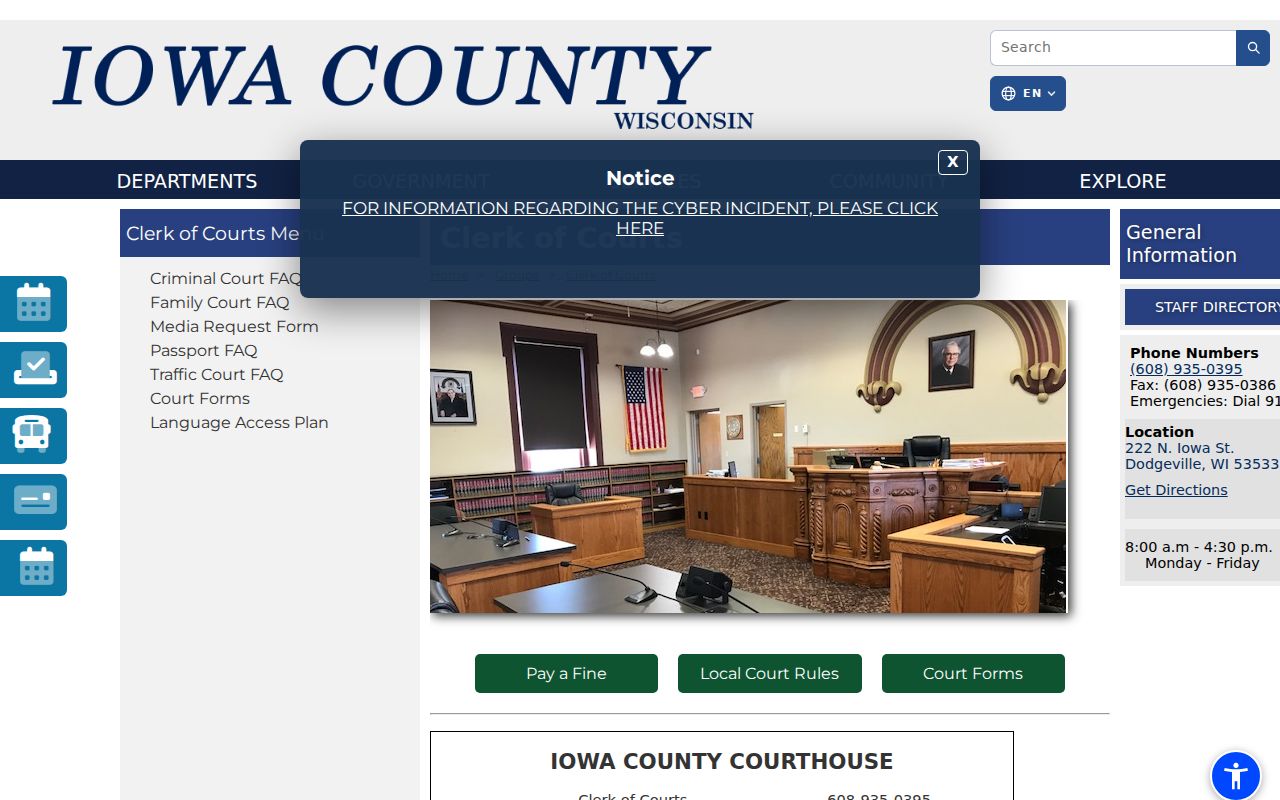
The courthouse channel supplies documents that the statewide docket does not display, making it essential for a complete Iowa County court-record review.
How a Criminal Case Moves
A criminal case may start with an arrest or a summons. The first court steps address the filed accusation, rights, counsel, and release conditions. A felony can include a preliminary hearing or waiver before arraignment. Motions and pretrial events follow. The matter then reaches a plea or trial, a disposition on each count, and sentencing after a conviction. Later review or appeal can add more entries.
Case flow: Charges Filed › Arraignment › Pretrial › Plea or Trial › Disposition › Sentencing
Terms have distinct meanings. An arraignment is the hearing at which the formal charge is addressed and a plea is entered. A disposition is the outcome of a charge. A judgment of conviction is the formal conviction and sentence record. Bond governs release before the case ends; Iowa County's FAQ explains that bond can remain with the case until disposition and may be applied by court order to case obligations or other debts.
Iowa County Treatment Court Records
Iowa County publishes contacts for Drug Treatment Court and OWI Treatment Court at 608-935-0343 and dtc@iowacounty.org. It also lists OWI Intensive Supervision at 608-935-0309. These programs do not create a separate public court system. The underlying filed criminal case remains in Iowa County Circuit Court, subject to the same public display and confidentiality rules. Program participation and progress should not be inferred beyond what the public docket or open court file states.
When counsel is needed, the Wisconsin State Public Defender locator identifies the Lancaster Trial Office as the office serving Iowa County.
The public defender channel concerns representation, not record custody. File inspection and copy questions still go to the circuit clerk.
Case Record Access & Restrictions
Wisconsin Public Records Law, Wis. Stat. §§ 19.31 through 19.39, begins with a policy favoring access but preserves express limits and the custodian's balancing test. Court-specific rules in Wis. Stat. §§ 801.19 through 801.21 protect identifiers and govern confidential filing, sealing, and redaction. Juvenile law-enforcement and court records are restricted under Chapters 48 and 938. A missing WCCA result is therefore not proof that no Iowa County matter exists.
Public screens omit Social Security, financial-account, driver-license, and passport numbers. Criminal victim and citizen-witness identities are not entered in public-facing fields, and juror names and addresses are protected. Unexecuted search warrants, sealed matters, and confidential cases are withheld. Ask the clerk whether a public file exists and what can be inspected, but do not expect staff to disclose protected content.
For an appellate record, use the Wisconsin Supreme Court and Court of Appeals search. Circuit financial obligations may be paid through the Wisconsin court payment service, which accepts Visa or Mastercard with a 2.75 percent service fee, or an e-check with a $1.95 fee. It does not display confidential or juvenile debt.
Iowa County Hearing Conflicts
Failure to appear can produce a warrant. Iowa County's criminal-court FAQ gives a specific route for a self-represented person who cannot attend: contact the District Attorney or write to the judge, and send copies to every party. A private call to the judge about the facts or desired result is an improper ex parte contact. Court staff cannot treat an informal message as permission to miss a hearing.
Confirm the current date and any order in WCCA, then follow the county procedure promptly. If a warrant may already exist, verify it with the issuing court and sheriff before making plans. The broader Iowa County arrest lookup explains why booking, agency, and court records remain separate even when they arise from the same event.
Note: A WCCA status label is informational; the Iowa County clerk's official file controls when online text and court documents differ.